St Peter's church De Panne


Religious heritage
Adaptive reuse of St Peter’s Church as a library.
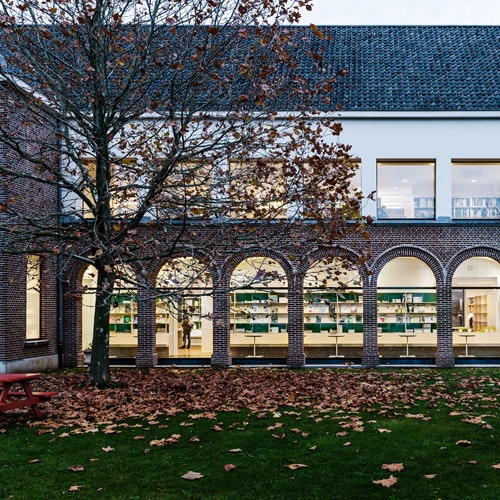
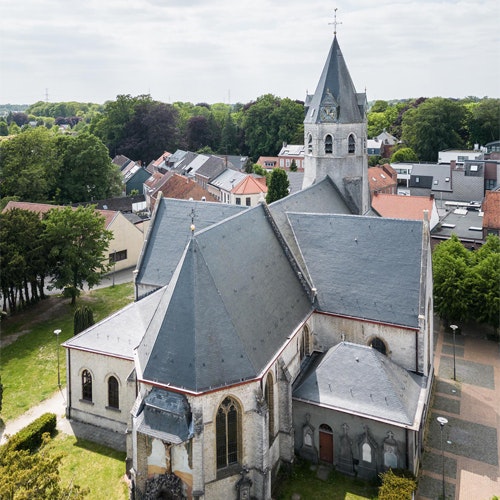
The transformation of St Peter’s Church in De Panne builds on a feasibility study exploring the building’s potential for future use. The church now houses a contemporary library that accommodates a range of activities alongside an accessible café. Designed in collaboration with Fallow and ACME, the project was shaped through dialogue with the local community, informed in part by the anthropological research and workshops led by Ruth Soenen.
The design seeks to preserve the integrity of the church, both externally and internally. New additions remain clearly legible while sitting carefully within the existing architecture. The openness of the church is retained, with the central nave kept free and the interventions respecting the continuity of the space. A new mirrored entrance gate creates an inviting gesture towards the surrounding neighbourhood.
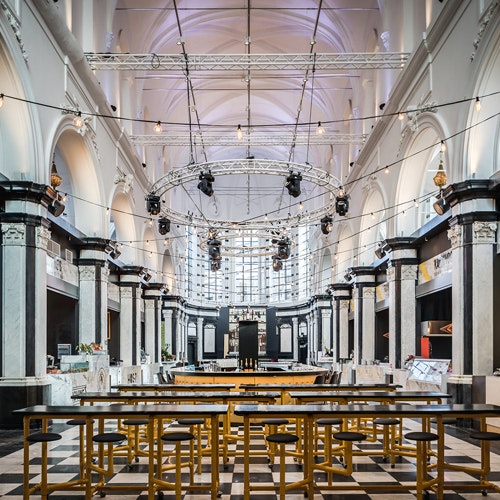
The central nave and north aisle, together with the church tower, form an open library landscape. Flexible elements accommodate a range of uses, from quiet reading corners to talks and larger events. A meandering acoustic textile installation and pivoting bookshelves allow the space to be temporarily divided without compromising its openness. Circular openings in the façades and rooflights introduce additional daylight in a playful way.
A lightweight timber floor has been introduced in the south aisle, where the fixed bookshelves are grouped together. To avoid overcrowding the main volume with books, a freestanding, two-storey bookshelf structure houses a substantial part of the collection. The new reading café takes its form from the church’s existing ambulatory, extending the rounded geometry of the chancel into a light, inviting addition that opens towards its surroundings. The new sacristy, by contrast, is conceived as a restrained contemporary volume, set back from the existing architecture. Both accommodate the supporting functions the library requires without compromising the openness of the church.
Additions to the existing building
The library is conceived as an open, multi-purpose space that can adapt to different uses. The textile installation, acoustic curtains, mobile bookcases, modular table systems and pivoting bookshelves allow areas to be temporarily screened off and reconfigured. The space can therefore shift easily between the library’s everyday activities and talks, events and other gatherings.
The existing materials have also been carefully considered. The original tiled floor was dismantled and relaid, with damaged tiles replaced by new ones. By combining old and new tiles in a wider range of colours, the design creates a renewed pattern that retains the character of the original floor while introducing additional variation and vitality.
Together under one roof
The project extends beyond the architectural interventions to encompass the complete interior design, from fixed furniture and bookshelves to digital library facilities, textiles and signage. Each element has been considered as part of a coherent whole.
The main space can also accommodate larger events and celebrations. Loose, mobile furniture can be stored beneath the bookshelf structure or in the storage area, while the pivoting bookshelves screen off the library section. Colour, materials and furnishings keep the spatial organisation clear and legible, even as its use changes. The church thus regains a public role, offering space for encounters and a wide range of community activities.